1. CASTLE HISTORY
Until the 17th century, Alsace was part of the Holy Roman Empire. It was then annexed by Louis XIV in 1697.
6th Century
1st mention of Kintzheim, under the name of Qwuningeshaim with the indication of « Regis Villa » (Royal Residence).
13th Century
1220
Construction of the medieval castle under the leadership of Frederick II of Hohenstaufen.
1267
The castle is given up to the Rathsamhausen family.
1273
Splitting of the castle’s shares by Rodolphe de Habsbourg who is in charge of managing imperial goods in Alsace. The castle is shared between the Rathsamhausen and the Kagen families (which generates strong tensions between them).
1286
Part of the village is sold by the Emperor to the Rathsamhausen family.
1298
The inhabitants of the village of Chatenois burn and destroy the village of Kintzheim and its castle.
14th Century
Near 1300
The Kagen and Rathsamhausen families reconcile and rebuild the castle over 3 years.
1341
The Emperor gives up the village to the city of Sélestat.
1378
The Rathsamhausen buy out the shares of the Kagen and change their name to Rathsamhausen-Kintzheim.
15th Century
1480
The Rathsamhausen-Kintzheim family branch dissapears. The castle falls to Gaspard de Morimont (Landvogt of Lower Alsace).
1492
The city of Sélestat buys the castle and undertakes renovation and modernization works. The castle has no longer a lord, but a bailiff (civil officer managing the property of a lord, of a town, etc.) employed by the city of Sélestat.
17. Jahrhundert
1632
Destruction of the village and ruin of the castle by the Swedes during the Thirty Years’ War
20. Jahrhundert
1964
The ruins are classified as « historical monument ».
1968
The Volerie des Aigles moves into the castle and brings it back to life.
2. CONSTRUCTION
The geographical location of a medieval castle responds to strategic interests, such as the control of a road, a valley, or a mountain massif…
When built in 1220, the primary role of Kintzheim Castle, was to take control back over the road to Sélestat, threatened by the Dukes of Lorraine, allies of the Rathsamhausen, owners of the Haut-Koenigsbourg castle.
Construction work requires specialized craftsmanship : quarrymen, stonemasons, carpenters, blacksmiths… All supervised by one or more project managers.
The nearby forest provides all necessary construction wood for frames, floors, scaffolding and construction huts (many itinerant workers settle on the construction site).
Quarrymen are in charge of extracting stones from excavations carried out for the construction of the building (digging of the ditch, foundations…) or from a quarry located close to the site (as for most Alsatian castles)
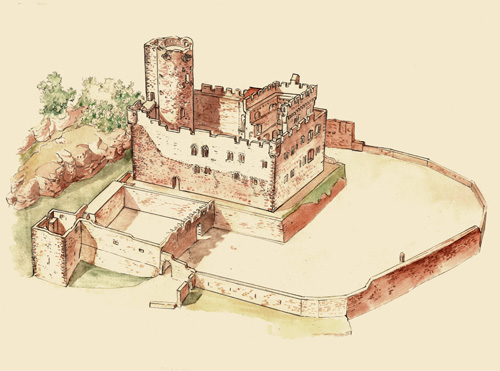
The main quarry of the castle could be located on the main parking area (P2).
Fortification type
This is a barred spur: entrenchment at the end of a rocky promontory cut by a ditch or a wall…
Building time
It depends on several factors: the financial investment of the future lord, the size of the castle, weather conditions, wars, workforce… In absolute terms, it takes between 5 and 10 years to complete such a castle.
3. FARMYARD
The farmyard is a bayle (or yawn): free space between two enclosures. This is the place of commons spaces like cowsheds, horse stables and some servants’ living spaces.
We can also find here :
The communal bread oven and press, which belong to the lord, but whose use is mandatory and taxed.
Vegetable and medicinal gardens, “garden of herbs”, can be cultivated there.
Many small animals, called “barnyard” animals : hens, roosters, geese, ducks…, and “intermediate” animals: pigs, sheep, goats…
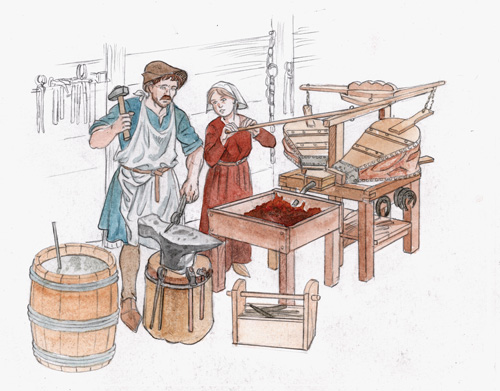
Several shops necessary to a castle’s life, like a blacksmith, a wheelwright or a carpenter… are established here.
A defense role
The farmyard is a part of the defense system. The attackers are forced to move accross it, leaving them completely exposed under the shots of the defenders. It is also the gathering place of the village’s population in case of capture by the enemy.
4. ROMANTIC PATHWAY
Called, « romantic » this pathway covers the rock on which the High-Castel and the dungeon are built and hasn’t any military or service use (regarding to interpretation hypothesis).
Role
Everything suggests that this infrastructure has been set up to make the visit to the ruin more attractive and more “romantic”.
Several elements support this hypothesis:
Passage under the latrines of the castle living spaces
Restricted access to the artillery tower (square tower at the entrance to the castle)
Blocked access to the underground located in the shield wall
Eased access to the High Courtyard …
Nowadays
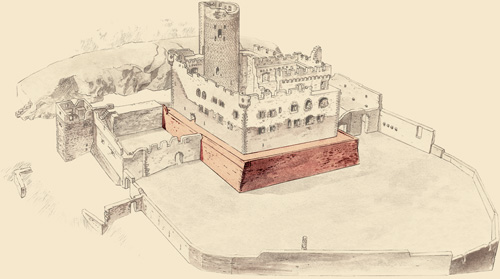
This pathway is walked by all visitors and offers many views of the surroundings.
5. HYGIENE
In an enclosed environment, such a castle, sewage disposal and personal hygiene are essential to limit the risk of disease and vermin. In the Farmyard, animal waste is used as a fertilizer in the fields or vegetable gardens.
1. Latrines (Toilets)
Unlike antique and monastery toilets, people do their « personal business » alone & individually.
The castle’s inhabitants use ceramic chamber pots for the night and latrines (remains visible on the top of the surrounding wall).
After-use cleaning is done with oakum (non-woven linen fiber, wad/stuffing) or old fabrics cutouts.
Excreta are evacuated in the ditch or in a cesspool (large tank), emptied daily to avoid pestilential smells.
Regarding to poliorcetics (art of attacking strongholds), latrines remain a weak point of the fortification, because they allow direct intrusion into the castle.
2. Body Cleansing
The lord takes baths, while peasants only wash visible parts of their bodies (hands, forearms, face…) and sometimes go to the public bathhouses.
On the other hand, full delousing is a daily routine. Complete body hair removal prevents vermin to locate into intimate parts.
Hygiene “kits” (with tweezers, earwax spoon, nail cleaners, etc.) were found in Alsace during archaeological excavations.
3. Bathtime
Besides body cleansing, bath is also a time for pleasure & lust, where having meals and drinks.
Men and women, take their bath together. At that time it was not considered a sin.
In town, public bathhouses often turn into libertine clubs.
6. SCENERY VIEWS
Various picturesque elements are to be observed thoughout the romantic pathway.
On your left side (NORTH-EAST) : the village of Châtenois (in the foreground), the village of Scherwiller (in the background) and Strasbourg Cathedral (on the horizon, depending on weather conditions);
In the middle (SOUTH-EAST) : the town of Sélestat, owner of the castle until 1649 (in the foreground) and the German Black Forest (on the horizon);
On your right side (SOUTH): the town of Colmar (in the foreground) and the Swiss Alps (on the horizon, depending on weather conditions);
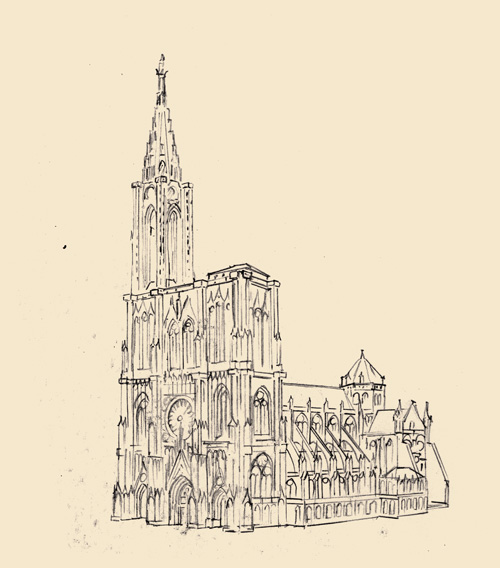
Detailed view of Strasbourg Cathedral
7. HIGH-CASTEL
1. Guardhouse
Access to High-Castel was probably regulated by four fortified gates.
The last door at the High-Castel’s entrance is composed by a guardhouse and two frames.
Engraved vestiges of board games were found in many castles, testifying that the guards played to kill time. To date, none have been discovered in Kintzheim.
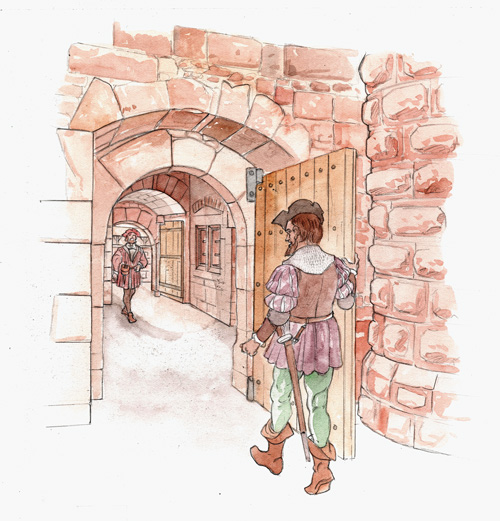
Latch systems in the frame
2. Kitchen
Meals are cooked here for all of the High-Castel’s inhabitants.
The kitchen is composed of a raised hearth (like in all Alsatian castles), with several fires dedicated to the different preparations.
A monumental hood collects the fumes and allows to hang meat or fish to be smoked.
Meal menus are elaborated by the steward according to the available stocks from the cellars. Daily hot meals usually include broth (soup) or stew.
During banquets, extra staff is often hired to make up for the lack of manpower.
In order to replace staff, automated rotisserie systems are developed using a propeller, driven by the hot air of a fire.
3. Water well
Drinking water supply is challenging for mountain castles. Springs are deep and sandstone does not retain water (which explains that the castle has no moats, but only ditches).
A filtration cistern collects rainwater from the roofs and walkways through a piping system (to be observed on the walkway before the square tower). By running off through sand and stone, water is loaded with minerals and filtered at the same time, before being stored in the cistern.
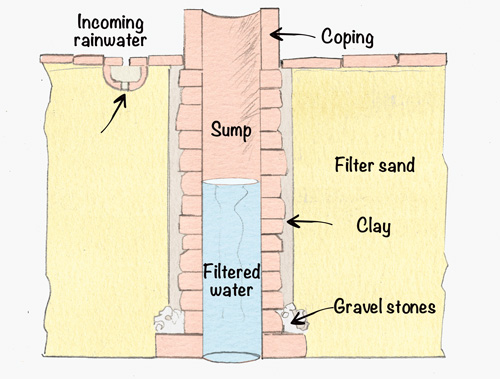
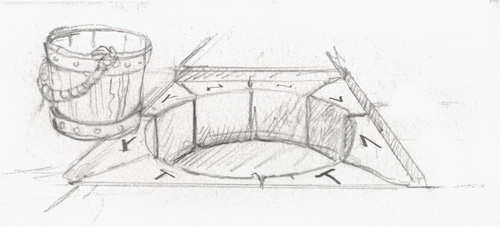
The castle’s water cistern is located under the Chapel and can be accessed by a water well at ground level (access now condemned).
8. THE CHAPEL
In medieval times, being a believer was an obligation. Daily life is thus punctuated by canonical hours (religious time).
The majority of the Alsatian population is Catholic, but the territory is also home to a large Jewish community.
All Alsatian castles possess their own chapel. That of the castle dates back to the 15th century and is dedicated to Saint-Jacques le Majeur.
It remains private and is only used for church offices bringing together the lord and his family, then the bailiff and his family.
Besides religious services, the chaplain is responsible for educating and teaching the lord’s children.
Myths & legends
This chapel is the source of many legends. The most emblematic one is that of a young woman, who heard whispers and pleas escaping from the vaults of the building on the night of Saint-Jacques (July 25)…
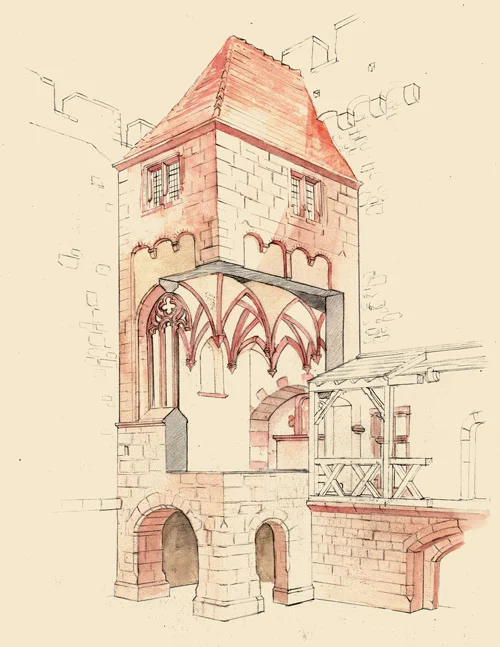
Above the chapel is the chaplain’s bedroom, which will be occupied by several hermits after the ruin of the castle.
9. CELEBRATIONS & BANQUETS
In Alsace, the main building of a castle is called the « pallas » (palace). It is a place for daily living, reception and pageantry. The main room, located on the “Ground floor” (over a half-buried cellar) is the most sumptuous in the castle with many tapestries, carved woodwork, painted ceilings, hunting trophies…
1. Furniture and Decoration
For daily life, there is only few furniture, but necessarily a credenza (ancestor of the hutch) on which is exposed the best crockery (glasses, aquamanile, vermeil dishes), as well as a few seats, cushions, and sometimes a « spannbett » (ancestor of the sofa bed).
It is only for receptions or banquets, that the table we will literally be set from two trestles supporting a wooden tray covered with a white tablecloth (which will be used as a napkin for the guests).
Tables are placed forming a U, the center being dedicated for service and entertainment. Guests are seated on benches, alternating between a man and a woman (children are never invited).
For banquets, guests use the castle’s tableware unlike daily meals, for which everyone brings its own, even if invited to the lord’s table.

Window seat
2. Customs and Entertainment
While seated at the table, habits and customs must be respected. For example, it is forbidden to wipe on the dress of the guest seated next, to put the hand on her/his thigh, or to talk with mouth full… under penalty of fine or exclusion from the table.
Musicians called “Minnensanger” and performers (acrobats, jugglers, bear tamers, jesters, etc.) are invited to enliven the meal.
Usually prohibited, other entertainements such as gambling (dice, cards, bets on races…), are exceptionally allowed but closely supervised by the clergy.
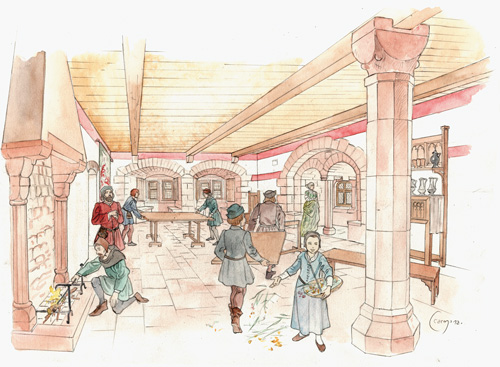
To perfume and bring color to the room, the floor is covered with fresh flowers or herbs depending on the season.
10. HEATING SYSTEM
Winter is harsh in Alsace, and mountain castles are often being isolated because of large amounts of snow. Intense cold slows down human activity. It is therefore essential to keep the heat in the walls of the house. There were two types of heating systems in Alsatian castles throughout medieval times.
1. Open fireplace
This type of fireplace has been found in Alsace since Roman times. The diffused heat can only be felt in front of it, leaving the back to cold. It almost has purely decorative function.
Its size and height enables to enhance the lord and to use more or less large logs.
2. Ceramic Wood Stove
This ceramic stove appeared at the end of the Carolingian period. It is used for heating “Stubes” (Alsatian living rooms), and allows a uniform distribution of heat throughout the room.
The raw material used for heating comes from the surrounding woods which belong to the lord. Many charcoal burners from the massif also provide fuel for the castle.
Braziers
They are used by guardsmen to keep themselves warm on patrol paths.
Insulation
Although windows are key to bringing light into the home, they also let cold coming through.
Before the 15th century, the glazing (uncommon at that time) was often replaced by a wooden frame covered with oiled parchment or coated fabric.
Wooden shutters help keep the heat in, but plunge the room into darkness. Another mean to prevent from cold and humidity is to cover the walls with curtains and wood paneling.
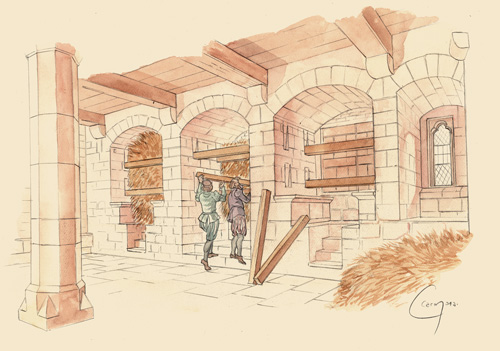
The notches on either side of the window seats (benches) can be used to wedge the beams to block the wooden shutters and to add straw to reinforce insulation.
11. CELLARS
Cellars are key to the management of the castle. During a siege, stock inventory helps define the maximum rationing period. Two cellars are identified in the High-Castle. The first one under the house, the second one under the Pallas.
The management and rationing of stocks is carried out by the steward.
15 to 20 persons live full time at the castle. Food supplies are to be provided for two meals and one snack per day and per person:
The disjejumium, morning meal at daybreak with bread, cheese and wine;
The Prandium, quick midday snack at the workplace with bread, dried meat and wine;
The Cena, full-course hot evening meal.
As opposed to popular belief, banquets are rare and prepared only for celebration days or visits from important people (prelate, burgomaster, provost, etc.)
This Arcanture used to give access to a room used as a cellar.
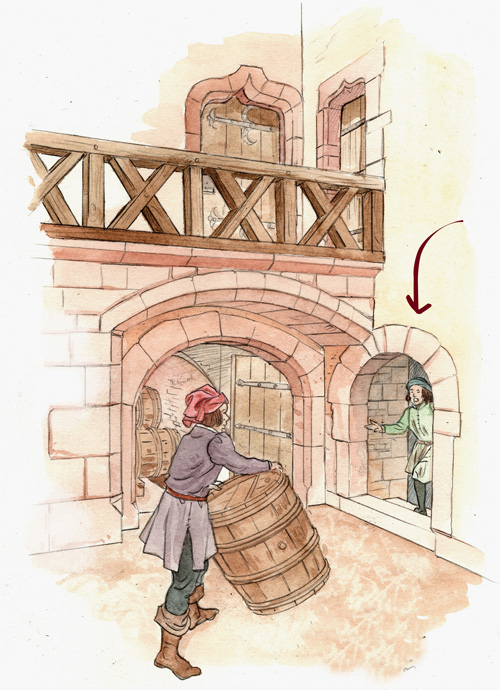
Cellar lighting skylight (on entrance side) visible from the outside climb.

Wine, then called Hypocras, is a common drink, even for children.
Wine-making process being not mastered in medieval times, wine was flavored and honeyed to make it more digestible.
Food preservation
Because food preserves did not exist at that time, people used to eat seasonal vegetables, and legumes, cabbage and squash during winter.
Meat and fish are salted, dried or smoked for preservation.
12. DEFENSE SYSTEM
A medieval castle is an enclosed space, surrounded by walls and flanked by towers ensuring its defense and protection. Different levels of support as well as an ultimate redoubt, the dungeon, also ensure to organize an in-depth defense.
1. Passive protection devices
Elevation of structures: clods, glacis, natural elevations…
Walls: ramparts, palisades, retaining wall…
Various obstacles: gabions, abattis, harrows, drawbridges…
Dug obstacles: ditches, pitfalls…
2. Active protection devices
Shooting devices: hoardings, bartizans, stunners, Maschiolation*
Tense firing devices: loopholes, patrol paths, crenellation…
* Machiolation are used to dump hot water, pitch, heated sand or excrement (but never boiling oil considered a luxury product). Furniture and stones can also be thrown at attackers.
The dungeon
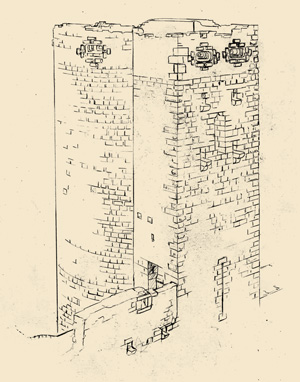
In Alsace, dungeons (called “Wohnturm”) are not used as dwellings but only as reduced areas (last defense space before the fall of the castle). It is also the place of command for the ramparts and towers in the event of an attack.
Its height testifies to the power of the lord (here, it culminates at 40m). In the 15th century, an artillery terrace was added to its top.
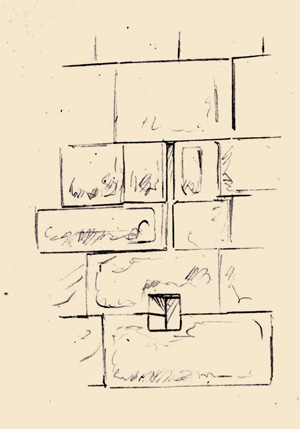
Stronghold Gunboat
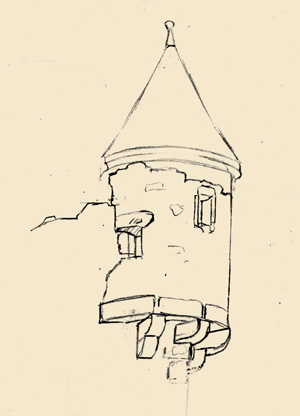
Watchtower
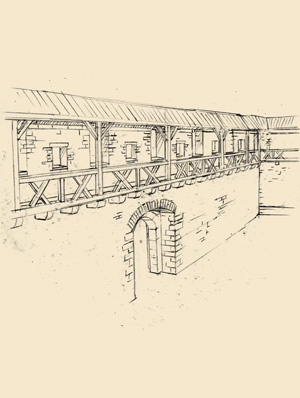
Patrol path
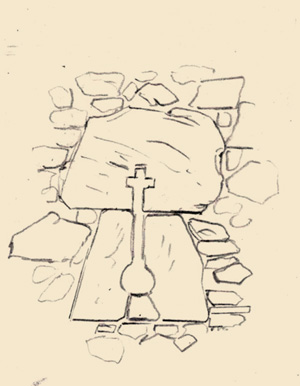
Cruciform loophole (for side looking)
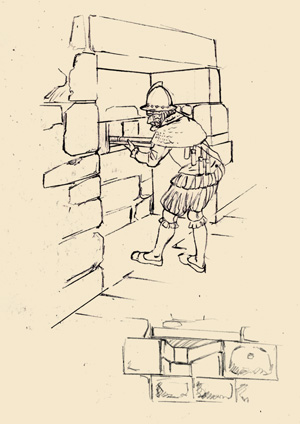
Loophole (inner and outer views)
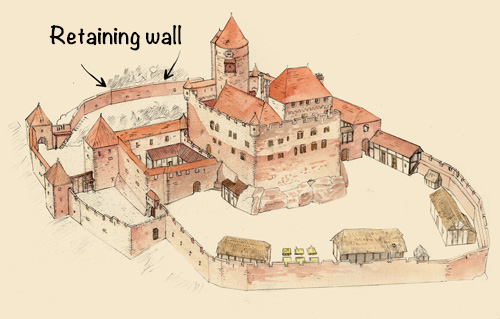
According to field observations, the castle of Kintzheim must have had a ditch as well as an advanced structure in front of the door: barbican and/or retaining wall. In the 15th century, it had a shield wall or screen wall (west wall). This wall, thicker than the ramparts, is oriented towards the threat and makes it possible to resist throwing weapons such as bricoles (mangonel, trebuchet…) and the first musket-slits (cannons).
3. The garrison
The garrison of an Alsatian castle is only composed by a few soldiers. In the 15th century. Kintzheim, had four men-at-arms and one sergeant.
Maintaining a troop is expensive and few lords can afford such an expense. In compensation for the lack of soldiers dedicated to guarding and maintaining order, each able-bodied man residing in the castle (with the exception of the lord) must devote part of his time to it.
System also found in cities (militia). In case of conflict, the lord requires (if any) his vassals and his peasants (ban) and/or mercenaries.
13. TRADE AND TAXES
The lord has duties towards his people, who have obligations back to him. In medieval times in Alsace, the peasants are “villains”. They are free as opposed to the serfs of the French kingdom.
1. The lord’s revenue
The peasants do not own their land but rent it to a lord, a city, a prelate or an abbey.
When the agricultural year ends on September 29 at Saint Michael, the peasants pay their due to the lord or the bailiff, almost exclusively in kind, few people having liquid cash (the lord has himself only a few obols for charity).
Thanks to its location, the castle benefits from other income. The control of a road and a watercourse generates transit taxes called “the granting”. The lord also receives income from his various possessions (woods, fields, other castles, communal oven, etc.)
2. Trade
Thanks to the extent of the Holy Roman Empire, encompassing a large part of Europe, trade with other countries is flourishing. Many exotic products were thus available in Alsace throughout medieval times: spices, silks, weapons, precious stones, art; moreover, the “Renaissance” began in the 15th century in the Empire.
To have cash, the lord can sell one of his possessions or contract a “usurious loan” from the members of the Hebrew community. Not only these people had to signify their membership of the Jewish religion by wearing a yellow wheel on their clothes, they were also limited to lender or livestock seller jobs.
14. THE POUND
A water device supplied by rainwater flowing from the walkway, is located at the bottom of the shield wall.
According to René Kill, this water device is a drinking trough for herdsmen leading their cattle to pasture.
In medieval times, it wasn’t located outside the castle as it is today, but was protected by a first rampart (today forming an embankment at the back of the pond), which was probably closed by a barbican (at the current location of the terrace).
The base of the rampart is widened by addition of an inclined wall, which one has several functions:
Strengthening of the rampart’s thickness,
Inconvenience for the installation of ladders,
Rebound for projectiles launched from battlements or hoardings.
Nowadays
This protected wetland reserve is home to newts, salamanders and other batrachians.
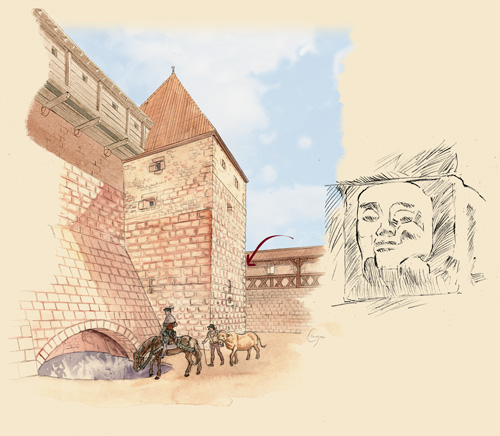
A carved grimacing face (called “Gaffkopf”) is to be observed at the corner of the west wall of the artillery tower (square tower).